And then it wasn't. Then it was again.
When I found out that I wasn't going to be able to bring the moto to Gabon, I'd already gone through the trouble of getting a Gabon visa, and paid the associated exorbitant fees, so I was going. Conveniently, Evan and Lisa had a 5-day weekend around the same time that I was going to be heading down, leading Evan to utter the above quote before we left Douala.
Inspired by my 6-hour Gabon visa turnaround time, the plan was to go to Yaounde (Cameroon's capital), apply for Evan and Lisa's visas, get them that afternoon and cross the border the next morning. We'd then do a quick 4-day trek across the country, ending in Libreville (Gabon's capital, where I am now), where those two would fly home and I'd continue on my adventure.
Unfortunately, international diplomacy and bureaucracy is incredibly fickle. As fickle, in fact, as the person sitting across the table from you when you sit down at the embassy. Regardless of most international regulations or any written rules (if they exist, and then if you can find them), whether or not you get a visa and how much you pay for it seems to be entirely up to the whims of the man or woman with the stamp. It was a good day for the Gabon lady when I showed up and handed over a pile of potentially useful documents (there was no list online, as the embassy has no website, and they don't answer their phone). Evan and Lisa, however, met the same woman on a worse day and, despite having far more documents than even I did, were refused the ability to even apply for the visa because they were missing one copy of a document (of which they showed her the original) that I did not even think to mention when I was there. C'est l'Afrique.
On to plan B. Intent on a vacation, Evan and Lisa decided to head to the beach to relax for a day before returning to Douala, so we hopped on another bus (at this point I was very much missing the moto) and crossed the country again. I spent the day with them eating fish, drinking Cameroonian beer and enjoying some time with good friends in a far away place, then we parted again; I went back east to Ebolowa and the border (by bus. Again), and they returned home to Douala.
So, I was back on my own, back on public transport, and back into the uneasiness and excitement that comes with entering a new country. This border crossing I knew by far the least about, other than that I would at least be able to keep my currency (Cameroon, Gabon, Congo, CAR, Equatorial Guinea and Chad all use the Central African Franc CFA). After a quick stop in Ebolowa, where I stayed with another PCV, Annie, I hopped a bus, then a moto, then a taxi to the tiny border town of Bitam in Gabon.
Since I didn't really know what to do in Gabon, I decided to spend the day relaxing and planning the next three weeks that I had in this new country. I'd heard that Gabon was more expensive than its neighbors (implying more well-off people, as well), and after seeing three or four cyber cafes in a town with only a single paved road with some side trails and a consistent supply of electricity, I was impressed. Little did I know that this would be the last time that I would see either of those things until Libreville.
Instead, my next week and a half in Gabon would be more dictated by the natural and village life around me than the developed, connected town and city life I had come to know in Cameroon. That being said, the expense of Gabon was not an exaggeration.
 |
| This is how much fun I have in expensive, jam-packed minibuses. |
My first stop was Makokou and Ivindo National Park, in the NW of the country. This is a park known for its jungle and the Kongou Falls, so I thought I'd try to go on a bit of a trek to see both. After overcoming the initial sticker shock, I decided to tag along with a couple of Austrian brothers, Ulrich and Clemens on a 3-day trek with the staggering price tag of $360 (This amount of money is almost equivalent to the amount I spent in my entire 3+ weeks in Tajikistan). Gabon was starting to look like Mongolia: expensive to get anywhere, expensive to do anything, hard to travel alone and especially on the cheap, but rewarding if you were willing to shell out a bit of cash here and there.
 |
| An example of a Gabonese hotel room. My back was against the opposite corner when I took this photo.I could see the neighbor's room through cracks in the boards. Still, more expensive than air-conditioned hostels in Central Asia. |
The Jungle
So, after a day of exploring the city, we were off! The three of us were loaded into a taxi, brought into the park, separated from our cash, then plopped in a
pirogue (dugout canoe) for our 2-hour ride down the Ivindo river, deep into the jungle.
 |
| Our guide preparing for the mini-rapids |
Immediately after setting foot in our camp, our guide pointed out some elephant footprints on the shoreline. This was just the first in many sightings of sign (elephant, boar, gorilla and panther tracks and scat) and live animals (mandrills, other monkeys, a type of otter, many birds, countless species of insect, spider and millipede, and eventually two live elephants!) Here are some of the few I was able to document, along with some vegetation. I apologize to the nature photographers and artists who read this (Floris and Jess in particular) for the quality of these photos.
 |
| Elephant footprints! |
 |
| Grasshopper. I should have put a finger in for size comparison, as they are equivalent lengths. |
 |
| Crazy vines. This one was over a foot thick in places and felt more like a tree trunk. |
 |
| La mante religieuse |
 |
| Fungi! It was tiny, size of a quarter each |
 |
| Panther poop! |
 |
| Millipede! |
 |
| Antfest. There were so many different kinds of ants in this jungle... |
 |
| earthworm writhing to escape the ants (unsuccessfully) |
 |
| flowering vine |
 |
| Crazy roots. Apparently they provide good shelter when an elephant is charging you. |
 |
| Crazy buttress roots. Not so helpful with the elephants, but good burial spots, apparently. |
 |
| Army ants in formation. The column is about 2in wide. |
 |
| Gigantic caterpillar! |
 |
| Part of the Kongou Falls |
 |
| The platform overlooking the falls with Remont, Ulrich and Clemens |
 |
| Leo, Remont, Clemens, Ulrich and I at another set of Kongou Falls |
Eventually, our time for adventures was over and we had to return upstream. We settled into the pirogue for a 3-hour ride back up the river. These hours were punctuated only by shifting position to hide from the sun, occasional bird sightings, and almost swamping the boat in a few rapids. Then, just as we thought we were out of the park and back on the road, we (almost literally) ran into two elephants! One was on a marshy island in the river (pictured below), while the other was on the bank. We watched them for several minutes before their huge bodies disappeared into the seemingly impenetrable forest.
 |
| Sleepy, sun-beat pirogue-ers on the way home |
 |
| ELEPHANT!!! |
 |
| Back to the "main" Ivindo NP camp |
Gabonese Transport, part 1
Once back in Makokou, the Austrians and I spent one last night together before parting ways (although I'll be meeting up with them again later this week when I go to Lambarene). My next stop was the town of Lope, a little equatorial village on the edge of another Gabonese National Park of the same name.
 |
| The minibus, and the roads. |
Thinking that transport here would be like other places I'd visited, I assumed that I'd be able to get some sort of bus or taxi or car or train from one tourist destination (Makokou) to another (Lope). Wrong. It turns out most tourists in Gabon either a) don't exist, or b) are rich enough to drive themselves, hire a car entirely for themselves, or fly wherever they want to go. Since I surely existed and was sorely short on cash (turns out only Libreville and Point Gentil have ATMs), neither of these applied to me. Instead, I was told to take a minibus to Booue, then hop a train from Booue to Lope. Easy enough.
 |
| Pangolin bushmeat. Yes, these are endangered. Yes, the lady in the car bought it for $5. |
Then I remembered that this is Africa. a 4-hour drive to Booue is actually 9+hours of finding a minibus, waiting for it to fill up, driving around town while the driver performs various unexplained errands, finally leaving, then stopping at every bushmeat salesman on the road (plentiful) so the lady in front can haggle for some illegal endangered (but delicious) meal. Once finally arriving in Booue, I figured the train would be easy enough to find. Wrong again. When I asked at the station about the next train, I was told that it wouldn't leave until the next day. Actually the next night. Actually, it left at 1am, so basically two days from now. "You want a ticket?" "No. Are there other options?" "I don't know, I just sell tickets." "Thanks..."
Just before I left to wander in search of a new taxi, a local came up to me and brought me to a couple of police officers. Until this point, all police officers in Gabon had done for me is look at my passport, try to find something wrong, then comment on all of my visas and stamps, so I didn't have high hopes for these two. In contrast, they told me to follow them over to the freight terminal and invited me up into the engine with the conductor to leave 20 minutes later on a train to Lope! Hitching trains suddenly became my new favorite form of travel.
 |
| Front row seat! |
Since I've already written far too much for one post, I'll limit my description of Lope. In short, it was similarly expensive for guided tours ($60-$150/day), much less jungle, much more savannah, many fewer animals for sighting (by me), and an even tinier associated town than Makokou. On the first day I teamed up with some teachers from the American International School of Libreville (one was a friend of Lisa's) for some overrated tours. The second day I decided to head out on my own to wander some of the trails of the park. I was hesitant to go off trails (I'd heard stories of "savanna vipers") or into the jungle (monkeys are scary...), so I stuck to the ridge trails, read a lot, took a nap, and walked back out of the park around dusk as thunderstorms approached, just in time to get a long lecture in French from half a dozen park workers who were appalled that I had entered the unmarked park grounds without a guide (an unposted requirement, apparently). I arrived back at my tiny hotel room just as the deluge hit.
 |
| 1500 year old rock carvings |
 |
| Turtle tracks |
 |
| Ogooe river |
 |
| Lope National Park |
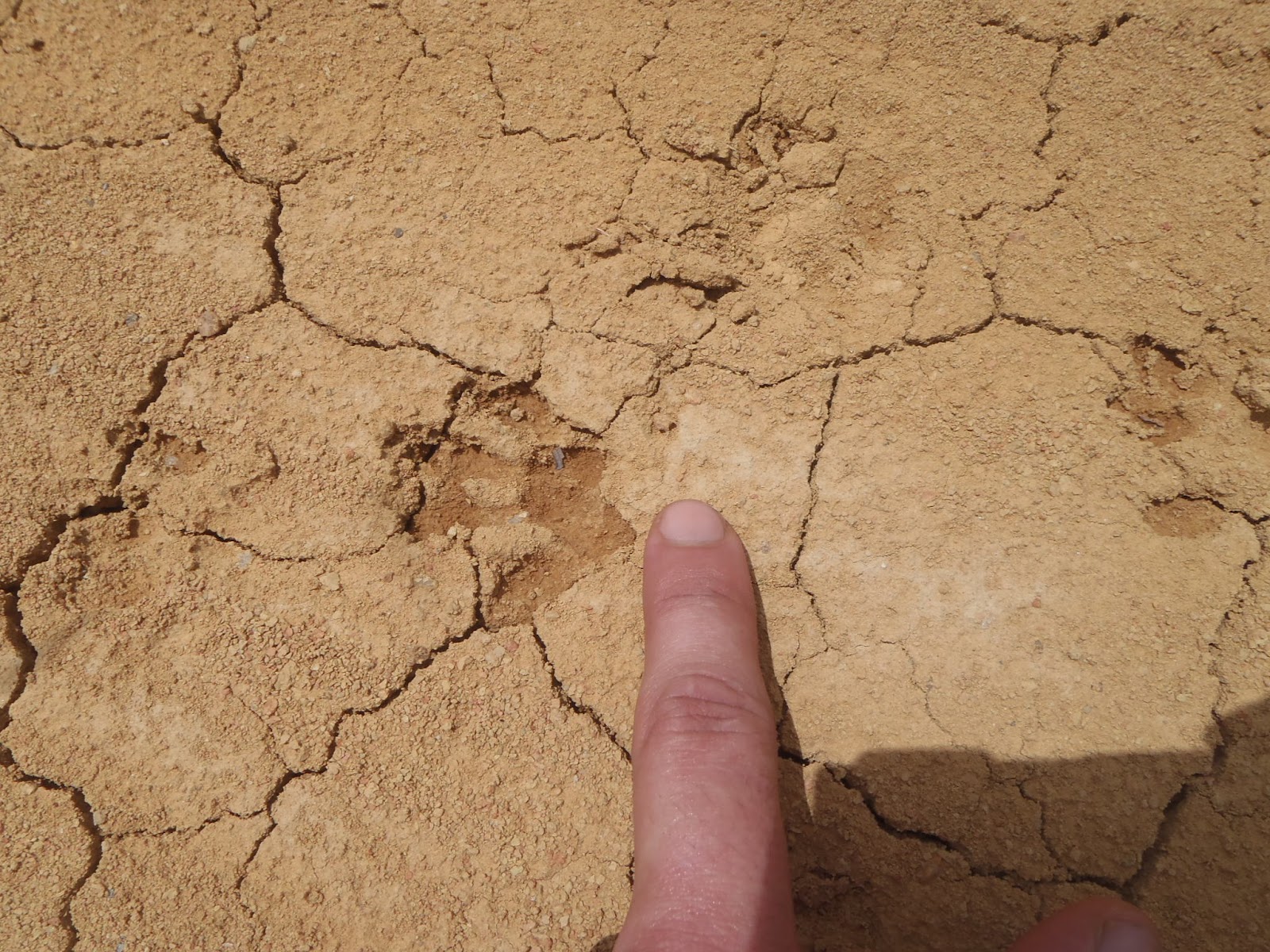 |
| Fun tracks, let me know if you identify them (finger for size comparison) |
Gabonese Transport, part 2
After my 2 days in town, I was out of money and it was time to get to Libreville, A/C and ATMs. I started by heading to the train station, asking about trains (again), hearing about the 3am train (again), asking about alternate options ("les AUTRES trains...") and then a first: The police officers at the train station told me something to the effect of, "Oh, you want to get to Libreville, you don't want to wait until 3am and you don't have much cash? You should just go into town and hitchhike! The trucks come through pretty often, sometimes they'll take you for free, or a little something. They'll have you to Libreville in no time!" Suddenly, my motivation for travel was rekindled. Hitchhiking in Africa? Done.
An hour later I found myself in the cab of a mercedes truck on its way from Franceville to Libreville. My driver was Cameroonian, so we were able to talk all about my time up there, politics, Central Africa and, of course, family. An hour after that, I found myself here:
 |
| How many truckers does it take to escape a mud pit? 11. |
One truck was already stuck in the mud (from the night's deluge) and one was crippled with 3 blowouts (probably from attempted tows), my driver managed to power through the pit and come out unscathed, which was lucky because he then got to tow his partner's truck out, then the two successful trucks together towed the original truck out, who then towed the next truck that came along and got stuck out, so finally traffic could move both ways. Meanwhile, the truckers who weren't actively involved in the towing operations were rearranging wheels and spare tires on the crippled truck.
La fraternite des chauffeurs
Libreville
Finally, after being dropped off at a broken bridge near Libreville 6 hours later, I hopped another two taxis into town, met with Nick and Terry, the teachers I'd met in Lope, and settled into their air-conditioned, wifi-enabled, laundry-machine-equipped, beachfront apartment. Luxury is nice, sometimes, even when it's relatively simple. I got to accompany them to their school this morning to explore and remember what it's like to get kids who aren't used to actually thinking about science to actually think about science. It was a good day.
 |
| Nick's classroom (SS/LA) |
 |
| Terry and his classroom (Science) |
What's next
I shall soon be leaving this lap of expensive luxury to make my way south to Lambarene, at least one other National Park, and eventually on to Congo! No telling when or where I'll find internet again, so no promises on the next post. Until then!


